The Ethical Explorer’s Guide: 5 Golden Rules for Respecting Costa Rica’s Wildlife
You dream of seeing sloths hanging lazily from rainforest canopies, monkeys leaping across trees, and toucans flashing their tropical colors overhead. Those fleeting, unscripted moments—when nature reveals itself freely—are what make a journey to Costa Rica unforgettable.
But too often, the excitement of seeing wildlife up close leads travelers to rush in, crowd animals, or rely on untrained guides. These seemingly harmless actions can stress wildlife, alter natural behaviors, and damage fragile ecosystems.
At Link Expeditions, we believe that travel should be a force for good. Every encounter in nature is a privilege, not a guarantee. And with the right awareness, your presence can help protect the very creatures and habitats that make this country extraordinary.
If you’re a discerning traveler who seeks authentic connection, values conservation, and understands that respect is the highest form of appreciation, these are the Five Golden Rules for exploring Costa Rica’s wildlife responsibly.
The Ethical Explorer’s Five Golden Rules
These simple and easy to remember rules transform your wildlife viewing experience from a simple photo opportunity into an impactful act of conservation, ensuring your presence benefits the ecosystems you visit.
Rule #1: Move Slowly and Stay Quiet—Let Wildlife Come to You
Rushing through the forest is the quickest way to see nothing but a flash of tail. This rule is a reminder about patience: understanding that the most rewarding wildlife sightings are earned through respect for the forest’s pace. It is the precise opposite of a rushed “nature” tour.
Earning the Sighting
Patience is your best lens. If you wait quietly in a spot identified by your expert guide, or if you are instructed to walk without sound, you dramatically increase your chances of spotting animals and witnessing rare, natural behavior that wildlife would never display under stress.
A couple of special moments come to mind as a direct consequence of this rule:
Subtlety in the Cave: Barra Honda’s Silence
In our explorations of the Barra Honda Caverns, we provide headlamps, helmets, and all the necessary equipment. As you descend the 17 meters using a basic series of anchored aluminum ladders, visitors are rightly excited by the feeling of descent and the unique view of the forest canopy shrinking above you. The comments and reactions of awe are expected as people learn about the ancient geological formations and local fauna.
But the real moment of connection happens when the guide asks everyone to sit on a rock, turn off their lights, and quiet down for just one minute. At first, the pitch blackness is so profound you cannot see the outline of your own arms, then the silence strikes you. It is a deep silence—a profound stillness that few have ever experienced. With your vision and hearing deprived, your body tunes into the remaining senses, creating an undeniable connection with the place, earned through a moment of silence and slowing down that otherwise would have gone unnoticed.
Spider Monkeys: An Aerial Lesson
There are four species of monkeys in Costa Rica, and the Spider Monkey is one of the most fascinating due to its amazing acrobatics and its agile, prehensile tail, which acts as a fifth limb. While sitting quietly under a tree one day, I was observing a troop of monkeys moving from tree to tree along what seemed like an invisible aerial road.
Suddenly, the distance from one branch to the next in an adjacent tree was too wide for a baby monkey to pass, and perhaps too wide for its mother to jump while carrying the baby. As I remained absolutely still and quietly observing, the mother solved the problem brilliantly: she held herself from the tip of one skinny branch using only her tail, swung across, and with one hand grabbed the closest branch on the next tree. She effectively created a living bridge that allowed her baby to safely move from one tree to the next.
Failing to stop and watch this subtle moment would have resulted in never witnessing this beautiful display of maternal ingenuity and the strengthening of their jungle bonds.
Rule #2: Never Feed or Touch
This rule is non-negotiable and represents the most direct way to honor the animal’s natural life. By maintaining absolute distance, you ensure the integrity of the ecosystem remains intact for both future wildlife generations and travelers alike.
The Cost of Interaction
- Feeding animals ruins their natural diet, leads to dependency on humans, and ultimately destroys their instinctive survival skills. A banana provided by a tourist is not a sustainable diet for a wild monkey.
- Touching, even gently, spreads diseases, introduces unfamiliar bacteria, and removes their necessary, healthy fear of humans. This interaction makes them vulnerable to predators and poaching.
- Don’t risk their life for a photo. The risk is not only to the animal, but also to yourself.
The real reward is knowing you contributed to their well-being by simply observing their lives—the highest form of respect in ecotourism.
A Lesson in Unintended Consequences
As I was sipping my delicious Costa Rican coffee prepared at Pura Vida Ride in Las Catalinas, I saw a tourist approaching a big black iguana (Ctenosaura similis). This one apparently was used to humans, as it didn’t retreat as they usually do. The tourist kept getting closer and extended an arm, offering a piece of fruit to the animal.
The iguana quickly lunged for the fruit and bit down. To my surprise and the tourist’s misfortune, the iguana not only bit the fruit but also the tourist’s finger. The tourist was left bleeding and in pain, and the iguana ended up with an accidental extra piece of protein.
This is a clear result of ignorance. Many people feed animals because they think they are cute or because they genuinely want to “help out,” not knowing that instead they are both exposing themselves to injury and harming the animal’s long-term survival skills in the wild.
Rule #3: Keep a Respectful Distance
The value of a memory is not measured by proximity. A respectful distance allows you to appreciate the animal within its stunning natural habitat. It ensures your presence remains bearable, granting you a privileged, non-intrusive viewing experience.
Technology Is on Your Side
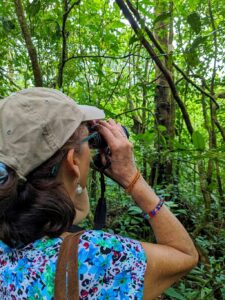
Always use your zoom lens, telescope, or high-powered binoculars—your equipment should do the work, not your feet.
Here’s a quick test for ethical distance: if the animal changes its behavior because of you, you’re too close. Back up.
A true expert guide will carry a spotting scope or binoculars to bring distant wildlife into focus without disturbing the environment.
If you are a naturalist at heart and wish to observe or photograph animals in their natural habitat, consider using quiet, neutral clothing and gentle movements to blend in. If you are serious about this, learn their habits and use the landscape as your cover, or rely on small binoculars or monoculars for a closer view. You might set up a simple motion-activated camera to capture moments when you’re not around, or watch remotely through Wi-Fi trail cameras that send images straight to your phone. For longer sessions, a small pop-up hide or camouflage clothing can help you stay out of sight, while natural plant screens or ground blinds offer an even steadier base. More dedicated observers sometimes use one-way viewing boxes, elevated hides, or powerful telephoto lenses to watch from afar. Those with a more technical spirit might explore remote-controlled cameras, night-vision or thermal gear, or even quiet drones—always within legal and ethical limits.
Rule #4: Support Ethical Experts and Eco-Conscious Lodging
This is the rule of stewardship. As a discerning traveler, your choices—where you stay, who you hire, and how you explore—shape the future of the destinations you love.
Every dollar spent becomes a vote for the kind of world you want to preserve. Supporting ethical experts ensures your travel investment directly contributes to conservation and community well-being.
Some Responsible Choices
- Lodging: Stay in boutique hotels or eco-lodges that actively protect the nature around them, often through private reserves, reforestation, or sustainable management practices. If you’d like our recommendations for trusted eco-lodges and boutique hotels, please reach out.
- Guides: Explore only with knowledgeable, certified local guides. They are trained to interpret wildlife behavior and ecosystems without causing disturbance, offering both insider understanding and an added layer of safety for you and the environment. At Link Expeditions, each excursion includes a private, experienced guide who provides meaningful context, supports your decision-making, and helps you avoid costly mistakes—for both you and the places you visit.
Rule #5: Observe, Don’t Interact
The purest joy of wildlife viewing lies in realizing that you are witnessing the complex, uninterrupted rhythm of life. By simply observing, you honor each animal’s right to exist undisturbed.
When you watch a mother monkey teaching her baby to climb, or a pair of toucans balanced gracefully atop a branch, you are seeing raw, authentic behavior—the true, priceless reward of patient observation.
The impulse to touch, feed, or intervene may come from affection, but it disrupts delicate routines and can endanger lives, social bonds, and natural instincts.
The goal is to be a silent, respectful presence—a ghost in the forest—never a participant.
Conclusion – Travel as a Privilege
Not everyone travels with this essential mindset—but you can.
When you move slowly, observe quietly, and choose guides and lodges that protect what they love, your journey becomes something deeper than sightseeing. It becomes an act of respect, a quiet contribution to the protection of Costa Rica’s wild heritage.
If you’re drawn to raw nature and care about your impact, choose experiences that make a difference. Support ethical ecotourism, travel with certified local experts, and spend your days learning, connecting, and giving back to the places that welcome you.
At Link Expeditions, we design journeys for the discerning traveler—those who want to explore, learn, and connect meaningfully with Costa Rica’s nature and culture. To continue your exploration, read our next post, watch our stories, or reach out to us for a curated experience that reveals the heart of this remarkable country.